About Us

Our Commitment to Transformative Change
3

CARE-HSC is a pioneering research initiative dedicated to fostering race equity through collaborative efforts and innovative solutions. Our work embodies a commitment to dismantling structural factors that perpetuate discrimination and equity imbalances in the care systems of the UK and beyond.​

Founded in response to the urgent need for racial equity in healthcare, our programme is backed by a Wellcome Discovery Award in 2025.

We have united leading researchers and advocates from King’s College London (UK), in collaboration with Black Thrive Global (UK), the Institute of Women & Ethnic Studies (USA) and Uppsala University (Sweden) in a comprehensive, seven-year study focused on real change. We have engaged with a wide range of stakeholders, from health care professionals to unpaid carers and community organisations. Our partners and collaborators span various sectors, reflecting our inclusive approach to improving health and social care systems.

2
3
4
5

Our Core Values​

We are committed to upholding core values that drive our mission for health equity and social justice.​

Centring Lived Experience

We believe the people most affected by racial inequities in health and social care must be at the heart of solutions. CARE-HSC works alongside carers, community organisations and the health and social care workforce; to ensure their voices, priorities, and expertise guide our research and impact.

Tackling Structural Inequities

Racism and inequality are embedded in systems, policies, and practices. We confront these barriers directly, generating new evidence, exposing harmful processes, and co-developing strategies that lead to fairer, more accountable care environments.

Innovating for Change

From participatory research to creative methods like film, theatre, and immersive technology, we use bold, interdisciplinary approaches to uncover hidden experiences and drive lasting transformation in health and social care.

Why Change Is Needed

The UK’s health and care systems rely heavily on racially and ethnicallyminoritised people in both paid and unpaid caring roles. Yet often their livedexperiences are overlooked, and the system fails to respond to their needs. 

Racially and ethnically minoritised carers continue to face:

  • Structural, interpersonal and systemic racism
  • Inequalities, discrimination and exclusion from care systems
  • A lack of transparency and accountability on key policies & processes 
  • Invisibility and under-recognition of informal (unpaid) carers
Together, we aim to centre the lived experiences of racially and ethnically minoritised carers, identify and disrupt the structural barriers that sustain inequities, co-create new evidence and methods, and drive policy change that embeds equity into everyday care.

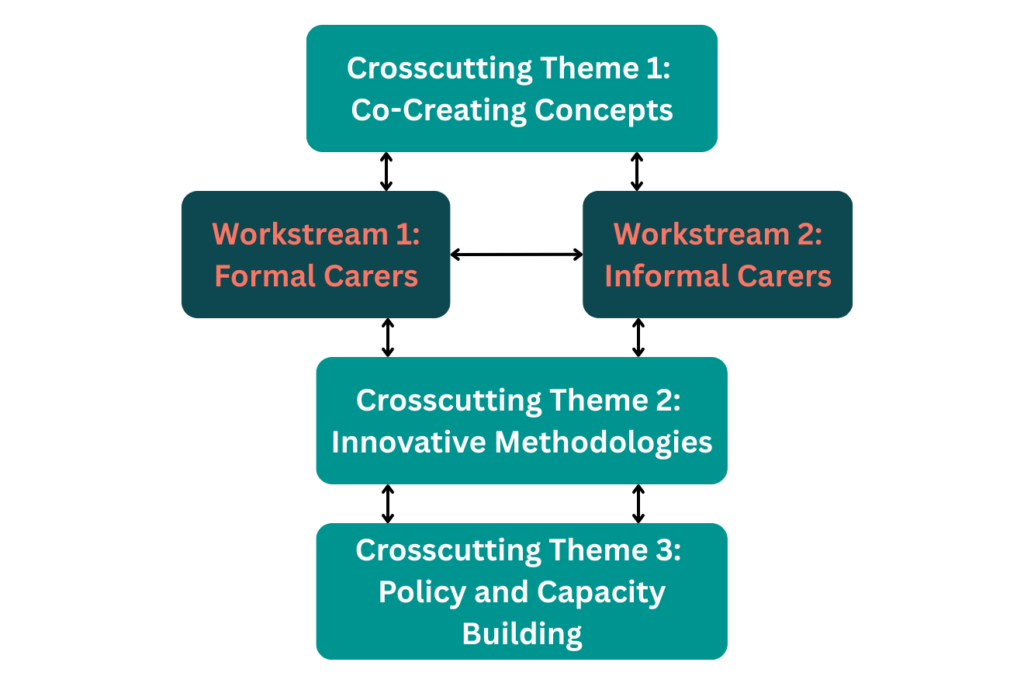
Integrated Workstreams

crosscutting theme 1 co creating concepts

Workstream 1: Formal Carers

Co-led by Professor Stephani Hatch and Dr. Rebecca Rhead​ Collaborate with NHS peer researchers to examine how racialised workplace cultures persist within care systems and impact workforce experiences, care delivery, and health outcomes.​
• Quantitative analysis of Race Equity in Care Survey and national datasets​ • Qualitative interviews with NHS staff, students, managers, and system leaders​ • Policy review of race equity and anti-racism approaches within education and the NHS ​ • PhD project (with NHS Race and Health Observatory) on how intersecting formal and informal carer identities contribute to inequalities in health and service use​

Workstream 2: Informal Carers

Co-led by Dr. Juliana Onwumere and Dr. Jacqui Dyer​ Collaborate with peer researchers to understand how racially minoritised informal carers are affected by, and resist, inequities in health and social care, and to co-develop culturally safe tools and models of integrated care.
• Quantitative analysis of the Race Equity in Care Survey and large longitudinal datasets​ • Qualitative interviews with racially minoritised carers ​ • Meta-systematic review of academic and grey literature​ • Develop anti-racism solutions and inform PCREF and policy​ • PhD project on implementing racially informed AI support tools for carers
Crosscutting Theme 1: ​Co-creating Concepts of Care
Co-led by Dr. Dörte Bemme and Dr. Hannah Bradby​
This theme co-creates new and inclusive theorisations of racialised care – across different ways of knowing (e.g. biomedical, social, cultural, and lived-experience) to address epistemic injustices and gaps in our current knowledge base.
Crosscutting Theme 1: ​Co-creating Concepts of Care
• ​Participatory research for more inclusive theories on racialised care​
• Interviews and observations with carers and health professionals ​
• Creative, decolonial methods to examine how racism constrains agency and opportunity​
• PhD project (with Black Thrive Global) to explore the lived experience of informal carers​
• Cross-national perspectives on carers’ illness experiences (UK and Sweden)
Crosscutting Theme 2: ​Innovative Methodologies
Co-led by Dr. Dörte Bemme, Iman Shervington, and Dr. Rebecca Rhead​
This theme develops and applies innovative, participatory methods to generate new data on racialised care experiences and tests creative approaches for learning, empathy, and action.
Crosscutting Theme 2: ​Innovative Methodologies
• Virtual Reality (VR): Co-created 360° VR films based on carers’ lived experiences​
• Collaborative Ethnography: Reflective practice on our processes (knowledge & action)​
• Race Equity in Care Survey: National survey capturing carers’ experiences​
• Human-centred design & co-production: Workshops and interviews with carers and stakeholders ​
• Actionable data & tools: Evidence to inform training, policy, and system change
Crosscutting Theme 3: ​ Policy and Capacity Building
Co-led by Dr. Jacqui Dyer, Professor Stephani Hatch, Dr. Hannah Bradby, Iman Shervington, and Dr. Juliana Onwumere​
This theme translates evidence into policy, practice, and learning, strengthening capacity for anti-racism change across health and social care systems.
Crosscutting Theme 3: ​ Policy and Capacity Building
• Policy analysis & action: Co-produced insights on institutional racism and change​
• Race Equity in Care Learning Module: Co-developed open-access training using VR and reflection​
• Systems influence: Inform and strengthen national and local initiatives across care systems​
• Global capacity building: Connect and strengthen networks across research, policy, practice, and communities​
• Leadership development: Support early career researchers in race equity work​

Meet the Team

Find out more about the team involved in Collective Action for Race Equity in Health and Social Care

Scroll to Top